What does a ULO do?
The problem, and the solution
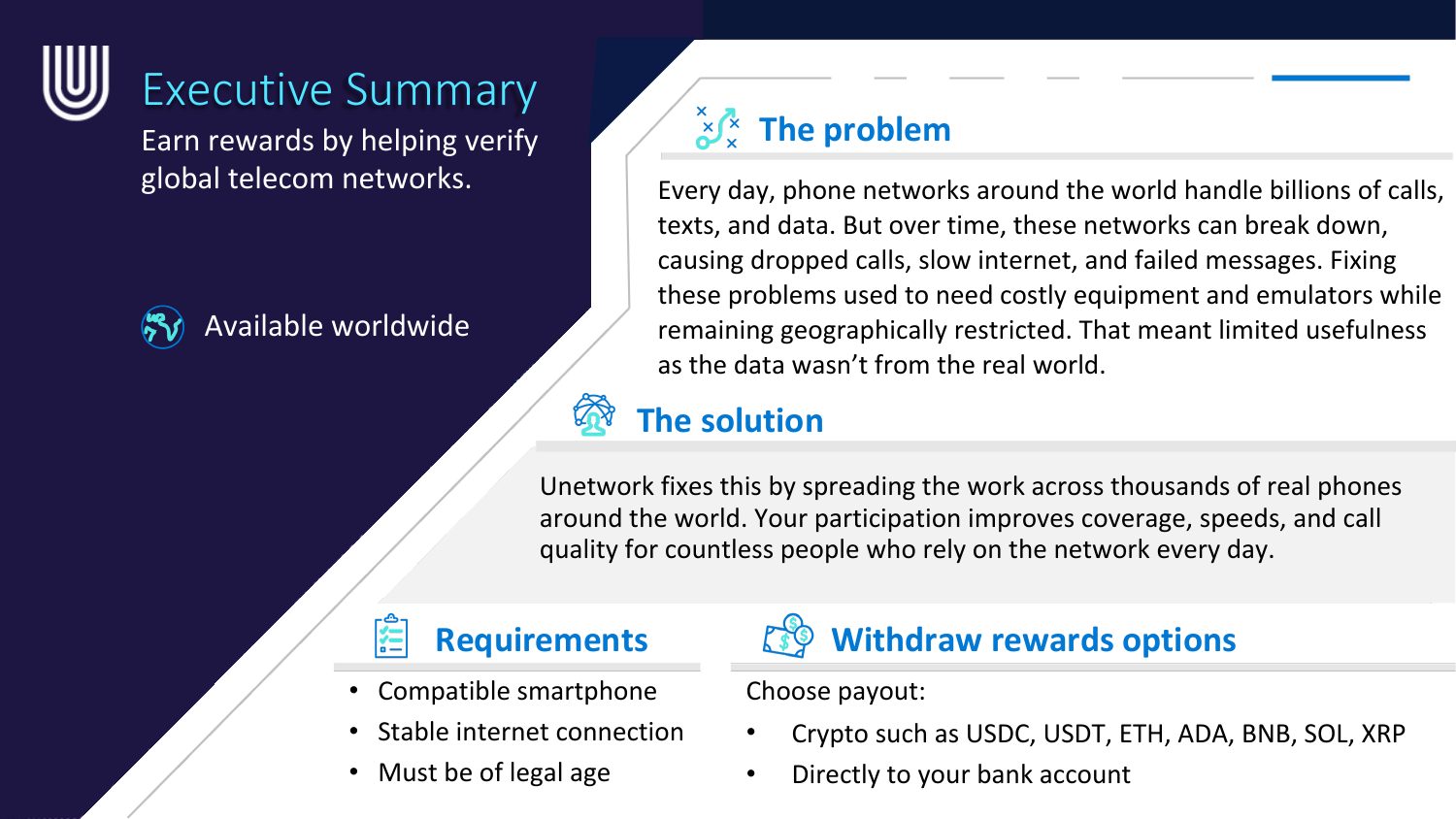
Every day, phone networks around the world handle billions of calls, texts, and data. Over time these networks can break down, causing dropped calls, slow internet, and failed messages. Fixing this used to require costly equipment and emulators while remaining geographically restricted — limited usefulness, since the data wasn't from the real world.
Unetwork fixes this by spreading the work across thousands of real phones around the world. Your participation improves coverage, speeds, and call quality for countless people who rely on the network every day. It's available worldwide.
- Requirements: a compatible smartphone, a stable internet connection, and you must be of legal age.
- Withdraw rewards: as crypto (USDC, USDT, ETH, ADA, BNB, SOL, XRP) or directly to your bank account.
Task overview
All tasks require a smartphone and a stable internet connection. Here's what's available today:
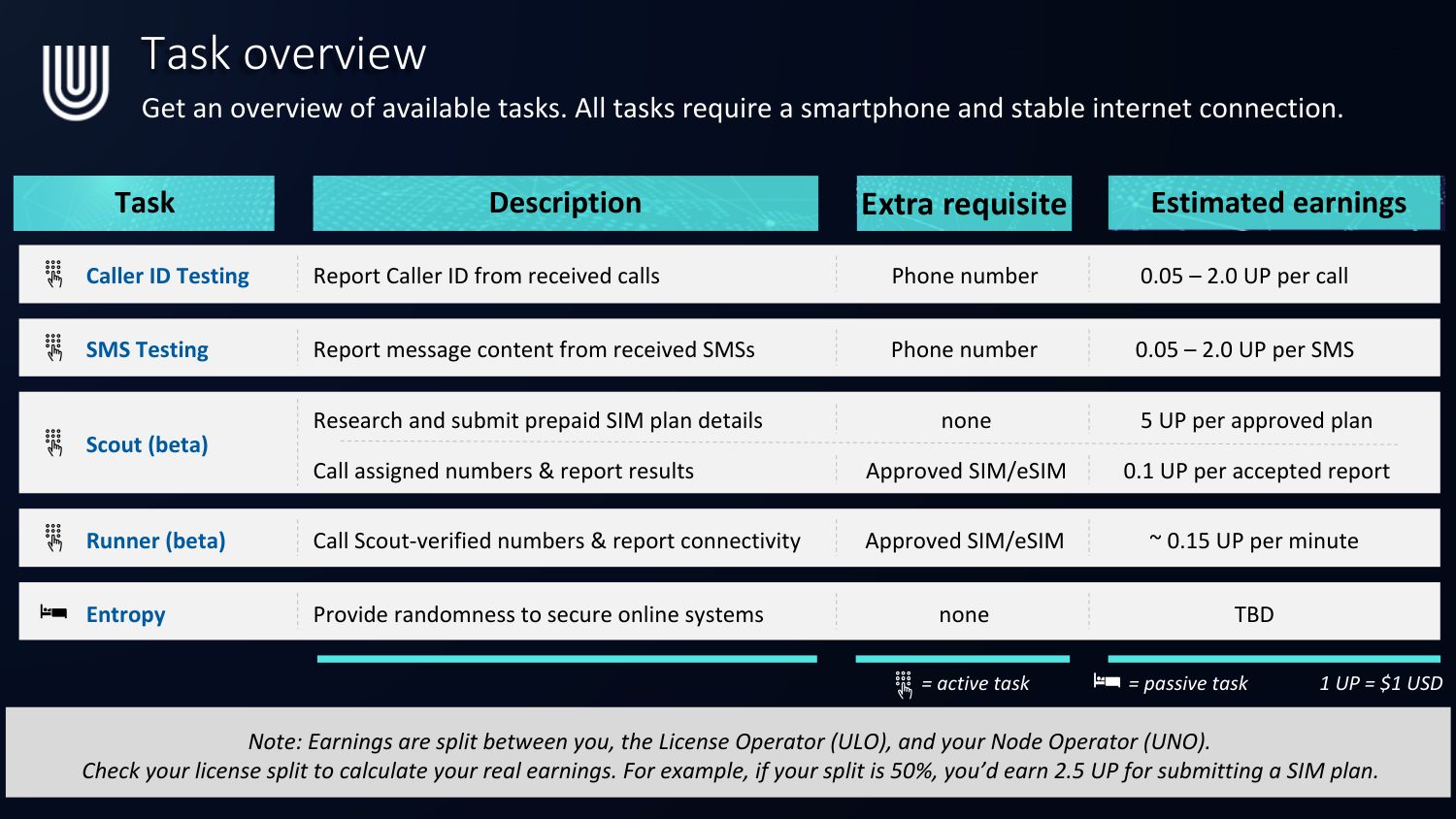
- Caller ID Testing — report Caller ID from received calls · needs a phone number · 0.05–2.0 UP per call
- SMS Testing — report message content from received SMS · needs a phone number · 0.05–2.0 UP per SMS
- Scout (beta) — research and submit prepaid SIM plan details, then call assigned numbers and report results · 5 UP per approved plan, 0.1 UP per accepted report
- Runner (beta) — call Scout-verified numbers and report connectivity · needs an approved SIM/eSIM · ~0.15 UP per minute
- Entropy — provide randomness to secure online systems (passive) · reward TBD
Earnings are split between you, the License Operator (ULO), and your Node Operator (UNO). Check your license split to calculate your real earnings — e.g. at a 50% split you'd earn 2.5 UP for submitting a SIM plan. 1 UP = $1 USD.
How Unetwork works
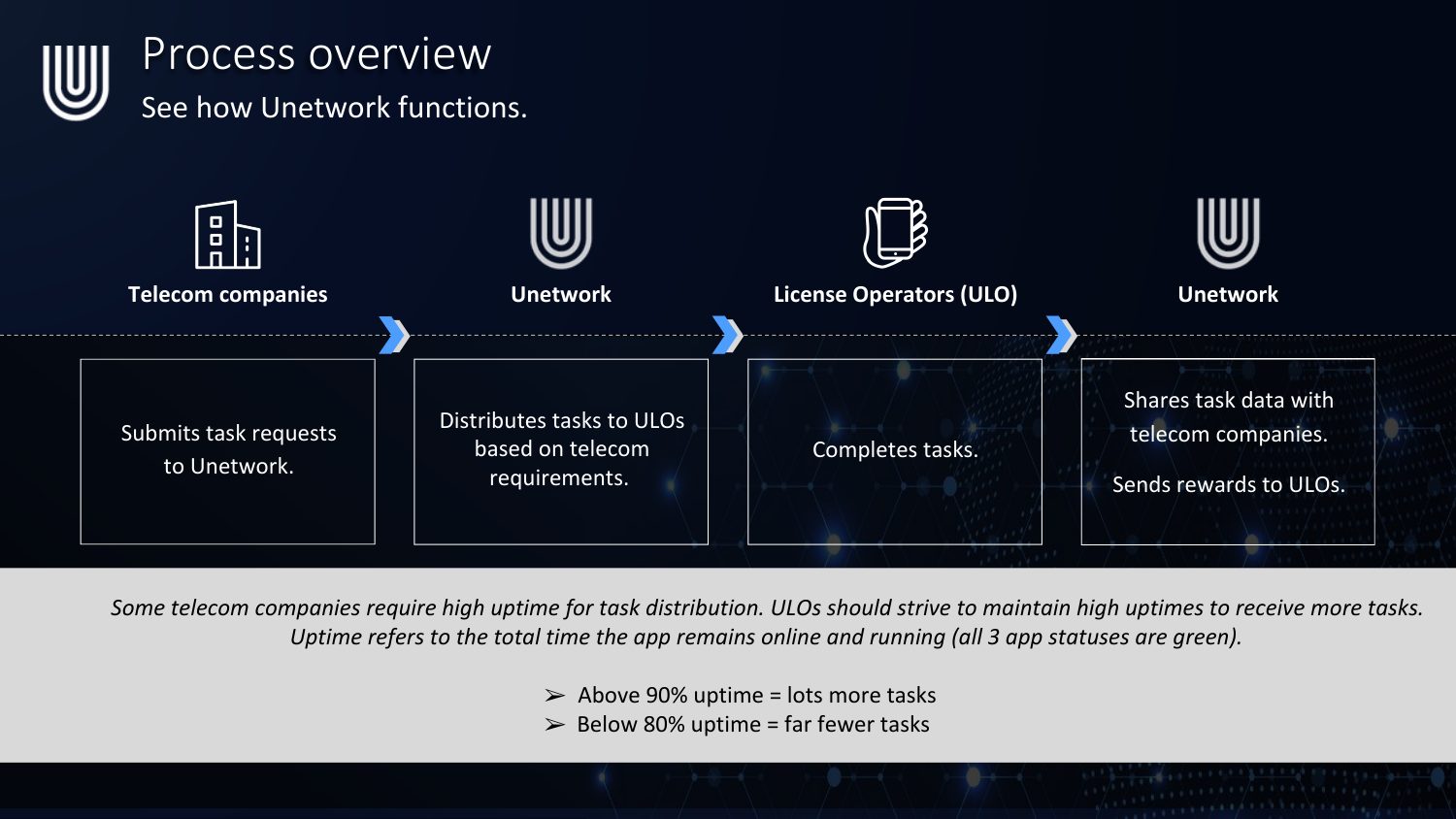
The process runs in a loop:
- Telecom companies submit task requests to Unetwork.
- Unetwork distributes tasks to ULOs based on telecom requirements.
- License Operators (ULOs) — that's you — complete the tasks.
- Unetwork shares the task data with telecom companies and sends rewards to ULOs.
Some telecom companies require high uptime for task distribution, so strive to keep your app online and all 3 statuses green. Uptime is the total time your app remains online and running: above 90% uptime means lots more tasks, below 80% means far fewer tasks.
Prefer the visual PDF version? Download the What Does a ULO Do? PDF